Sunday, May 22, 2022

Noar Hill

For several reason, except for one visit to Hillier Gardens last month, we've not yet been able to go out butterflying this year, and we felt that really had to change! So we decided to go to Noar Hill, in the hope of seeing a couple more species than the nine we'd seen so far, and also with crossed fingers for seeing Dukes of Burgundy, which would be a new species for us ...

Almost immediately after entering the reserve, we saw a few tiny butterflies flitting about: small blues! We'd only seen this species once, and then very briefly, so it was great to be able to spend a bit more time with this really cute butterfly. One landed on Irma's hand, and a second one provided me with a real photographic challenge by landing on my camera ....


It turned out that small blues were by far the commonest species today; they really were just about everywhere!

And then we saw a few dingy skippers, a new species for us! We saw several spread throughout the reserve, but they wouldn't settle long enough for a photo, sadly ...

As we explored a hollow which really trapped the warmth from the sun, ...


... our first Duke of Burgundy, the second new species of the day! Several more were to follow.


Besides the species already mentioned, there were also many small heaths about and we saw several green hairstreaks. Here's today's full table, with the first new species of 2022 (one = 1; few = 2-4; several = 5-9; many = 10+):

Friday, April 15, 2022

Hillier Gardens

Although I'd already seen three species of butterflies this year (brimstone, comma and peacock), we'd not yet gone out to butterfly specifically. A beautiful sunny day in the easter break seemed perfect to go to Hillier Gardens (where we had our final day of proper butterflying last year) and do just that!

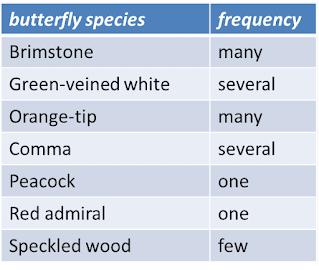
A calm day, the warmest day of the year so far, perfect for butterflies. We saw seven species in total, including many brimstones and orange-tips (most orange-tips I'd ever seen in a single day). 

Of course, we did keep an eye out at the different water bodies for the first large red damsels of the year, but, alas, no luck ...

So here's the first table of 2022 (one = 1; few = 2-4; several = 5-9; many = 10+):


Wednesday, January 19, 2022

Moths ...

It probably was to be expected, a natural development. After I developed interest in hawk-moths, it didn't take me that long to start thinking about getting to know other moths a bit more as well. 

So ....


My intention is definitely not to go out moth-ing in the same way I go butterflying, damselflying and dragonflying. But whenever I do come across a moth, I will try and figure out which species it is. That will of course be easier with macro-moths than with micro-moths, but it'll be fun just to have a go!


Monday, December 20, 2021

Hawk-moths - honorary butterflies

Several times this year, I saw a hummingbird hawk-moth, first in our front garden, and then, a month or so later, at Hillier Gardens. 


The picture above of a nectaring hummingbird hawk moth isn't mine (sadly!), but is taken by Charles J Sharp. 

Hummingbird hawk-moth is not the only hawk-moth species I've ever seen. In the past, I also saw elephant hawk-moths a few times (again, the picture isn't mine, but comes from this web-site).

In addition to these two species, I have seen one or two others in the past, but wasn't able to identify them then. 

Hawk-moths really appeal to me, even though they're not butterflies. So what are they really? Where do they fit?

First of all, they are lepidopterans, just as butterflies are. So they are related to butterflies. But not very closely. This phylogeny (from this published paper), based on DNA data, shows where they fit within Lepidoptera. All butterflies belong to the superfamily Papilionoidea, just above the centre in this tree, whereas hawk-moths are all in a family called Sphingidae, at the bottom of the tree. 

Another tree, from this published paper, based on different DNA data, tells basically the same story.


Hawk-moths (Sphingidae) belong to a superfamily called Bombycoidea, together with emperor, moon and luna moths (Saturniidae), and silk moths (Bombycidae), plus a few other, less well-known families. By the way, the largest moths in the world (atlas and hercules moths) also belong to this superfamily

To give you more of feel of this superfamily, here is an emperor moth (picture credit, Chris Lythall, this web-site) ...


... a luna moth (Michael Crowley, this web-site) ...


... and a silk moth (from this web-site).

To help me identify hawk-moths from now on, I ordered this easy fold-out guide to Britain's hawk-moths published by the Field Studies Council.


As the title of this blog posts states, hawk-moths are honorary butterflies to me!

Tuesday, November 9, 2021

Recap of 2021

On a walk last weekend, with the weather sunny, but quite cold, I saw a red admiral and a speckled wood. And those two may well be the last butterflies I'll see this season .... 

So it's time to recap the 2021 season!

Let's first look at the garden. Our garden list from last year had a total of 16 butterfly species and a single damselfly. How did we do this year? Despite planting more butterfly-friendly plants, we did not see more species. Fewer in fact: 13 in total, and no species that we hadn't seen last year. 


On to damsels and dragons, last year we only had a single individual in the garden: a large red damselfly. This year, we saw a total of five species! 


And the golden-ringed dragonfly even entered the house .....

At the start of the year, I drew up target lists of species we wanted to see this season. This because we only started looking for them quite late in the season last year (especially for odo's), so missed quite a few relatively common species that are active earlier in the year. Quite ambitious target lists: 10 new butterfly species, and 10 new damsel/dragonfly species. So how did we do?

Of the 10 target butterfly species, we saw nine, plus two species I had seen in the dim and distant past, but Irma hadn't. In order of first time seen this year: grizzled skipper, small blue, large skipper, silver-studded blue, purple hairstreak, small skipper, purple emperor, white admiral, brown hairstreak. Plus green hairstreak and dark green fritillary. The only target species we did not see was essex skipper. We may have seen it, though, as we couldn't identify every single 'smessex skipper', but we never had a positive identification of an essex skipper.

And then damselflies and dragonflies. Again a target list of 10 species, and we saw them all, plus five more! Again, in order of first time seen: broad-bodies chaser, four-spotted chaser, beautiful demoiselle, southern damselfly, azure damselfly, hairy dragonfly, downy emerald, black-tailed skimmer, small red damselfly, red-eyed damselfly, brown hawker, emerald damselfly, small red-eyed damselfly, black darter, lesser emperor. 

So 24 new butterdamseldragon species in total this year. It was so much fun seeing so many new species! We'll never have another year like that, of course; next year will be different, enjoying seeing the different species become active again, and still hoping for a few new ones. 

Bring on 2022!


Sunday, September 26, 2021

Hollybrook Cemetery

Hollybrook Cemetery is behind our back garden, and if the weather is nice late afternoon, we tend to take a walk across it after work. Especially the slightly more overgrown parts of the cemetery are nice places to look for butterflies! Rather than blogging each time we go there, I thought it would make more sense to combine everything into one blog post. 

We saw a total of ten butterfly species at the cemetery this summer, the commonest of which were small skippers, meadow browns and marbled whites. 


Now there are lots of big oak trees scattered around the cemetery, and we made sure to bring binoculars when the weather was particularly nice and scan the tops of those oak trees. Didn't take us long to see the silvery undersides of the wings of purple hairstreaks! New species for us then, even though we did see one at Abbotts Wood later.


And we did see a dragonfly once: a black-tailed skimmer female landed on a gravestone, but took off again before I could take a picture.

Here the end-of-blog-post tables, indicating the highest number we saw on a single visit (one = 1; few = 2-4; several = 5-9; many = 10+):


Sunday, September 5, 2021

Hillier Gardens, one final hurrah

Although I was pretty much convinced that our visit to Old Winchester Hill last week would be our final day of butterflying this year, the weather was so nice this morning that we took the snap decision to go to Hillier Gardens for the day, for one more butterfly day. Last year, in September, we only saw four species of butterflies at Hillier Gardens, and so we certainly didn't expect to see the 14 species we saw in July this year. 

Surprisingly, and possibly due to the warm sunny weather, we actually saw a total of nine species, seven of which on a single large Buddleia bush! Included in those seven species was small tortoiseshell, which we hadn't seen at Hillier before. 


By far the most common species were brimstones, small whites and red admirals (the latter especially on and around Buddleia bushes).


In addition to the nine butterfly species, we saw a hummingbird hawk-moth, and I consider hawk-moths as honorary butterflies (even though, technically, of course they aren't). I tried to take a picture, but it was just too fast-moving and didn't stay in one place long enough. 

In terms of odo's, many common darters, as expected, but also a few golden-ringed dragonflies, which were new to us for Hillier Gardens last time.


Just before we left, I saw this heavily-damaged peacock fluttering about; it's clearly been through the war and back! To me, it really captured today almost surely being the final hurrah of the 2021 butterfly season ...
 

But we still have today's tables to present (one = 1; few = 2-4; several = 5-9; many = 10+)! Mentally add the hummingbird hawk-moth ....