Sunday, May 30, 2021

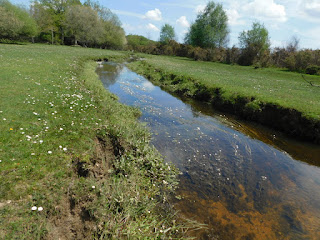
Mill Lawn Brook

Day 2 of the May bank holiday, so damselflies and dragonflies the focus of today! We set out to Mill Lawn Brook, in the hope of seeing a few (for us) new species.


Weather was glorious, and little wind, so should be a perfect day for damsels and dragons! We saw many large red damselflies (quite a few in tandem, mating of ovipositing) and a few broad-bodied chasers (new species for us!). 


Plus a single butterfly: a small copper.

So not exactly the biggest haul ever, but it was a great to be out and feel the warmth of the sun, after the cold spring.


The usual tables (one  = 1; few = 2-4; several = 5-9; many = 10+):


One more thing: high up on our wish list for today was a beautiful demoiselle. As you can gather from the table above, we didn't see this species. Well, that's not quite true .... we did see a beautiful demoiselle, a female .... floating in the stream .... dead ....


Saturday, May 29, 2021

Magdalen Hill Down

April and May have been very cold (and wet, on occasion), but with the bank holiday approaching, the weather seems to have turned. Plan for us for the bank holiday was to go butterflying one day, dragonflying one day, and then have one day in reserve to either butterfly or dragonfly, depending on days 1 and 2. 

For the Saturday, we decided to go butterflying, and go back to Magdalen Hill Down for this. Last year, in late August, we saw eight species. What could we see this much earlier in the season?


Weather was pleasantly warm, with hazy sunshine and some wind (much less than last year!). Flowers were certainly present, although everything is late due to the cold spring.


We saw a total of 12 species, two of which (grizzled skipper and small blue) were new to both of us, whereas green hairstreak was new to Irma (I'd seen them in my youth many many years ago in the Netherlands, so it was great to see them again, after maybe 40 years or so). Even though we saw more species than last time, the number of individuals was much lower. Only brimstones and small heaths were common.

So here's our list for today (one  = 1; few = 2-4; several = 5-9; many = 10+):


And, finally, we noticed this sign on one of the access gates to the reserve. Fingers crossed we will see dukes here one day ...

There certainly was an abundance of cowslips!


Saturday, May 8, 2021

Valley Gardens @ University campus

At the centre of the University of Southampton's Highfield Campus is a small oasis of peace and quiet, called the Valley Gardens. Due to the covid situation, teaching has been almost exclusively on-line for me, but yesterday I had to be on campus for two face(-mask) to face(-mask) workshops. A lunch break separated these two workshops, and I decided to have lunch in the Valley Gardens, and walk around a bit, in the hope of seeing some butterdamseldragonflies.

Weather was mostly cloudy, but every once in a while, the sun came through. As the air warmed up, a handful of butterflies came out to play; five species in all (see the table at the end of this post for more details). 

Valley Gardens also has a few small ponds, and of course I checked these out for damselflies and dragonflies. Seeing no activity, I was about to leave when I spotted a large red damselfly resting on a stone slab. 


We definitely need to go back here for a proper butterdamseldragon trip a bit later in the year, when it's warmer and there are more flowers out. Also because the large oak at the end of the garden is said to have a colony of purple hairstreaks ...


The usual end-of-post tables (one  = 1; few = 2-4; several = 5-9; many = 10+):


Saturday, May 1, 2021

Hillier Gardens, again

So far this season, we've seen seven butterfly species in the garden, and one damselfly (large red) on Southampton Common, but we haven't yet actually gone out specifically on a butterdamseldragon trip. And we felt that the start of the May bank holiday would be a nice occasion to go to Hillier Gardens again, and see what we could see. After all, we'd been there last year, not once, but twice, and it gave us a good haul of butterfly species (10 to be precise).

Weather was cool, but dry (until just before we left), and the sun did come out a few times. Once that happened, and the air noticeably warmed up, some butterflies did come out to play: a few orange-tips, several small whites, and a single speckled wood.


Not nearly as many species as last year, but the speckled wood was one we hadn't seen there before!

Of course, we also checked the ponds several times during the day for damselflies and dragonflies, but no luck ...


So here the table usually given at the end of a blog post reporting on a butterdamseldragon trip (one  = 1; few = 2-4; several = 5-9; many = 10+):

Thursday, March 25, 2021

'Butterflying up' the garden

Last year, we saw 16 butterfly species in our garden. Given the size of our front and back garden, I think that's a pretty decent number, and one that certainly sets a benchmark for this and future years. 

The most popular plant in the 'wild flower meadow' front garden was Verbena, which will no doubt attract butterflies again this year. We decided to add some Knautia as well as replace a dying Azalea with two Buddleia bushes (one with white flowers, one with purple flowers); can't go wrong with Buddleia, can you?


In the back garden, a single large Buddleia bush was the real butterfly magnet last year. We put pots with Liatris, Hebe, mint, rosemary, lavender, thyme and marjoram around it. Hopefully, this larger and more varied patch of butterfly plants will be even more attractive than the single Buddleia bush.


The first few garden butterflies have already been spotted: three peacocks and two brimstones. We'll see over the next half a year or so whether the additions have worked and attracted more butterflies to the garden. Fingers crossed; expect a 'Garden list 2021' post come October!


Wednesday, March 3, 2021

Butter, damsel and dragon plans for 2021

Last weekend our butterfly season officially started when we saw about a dozen brimstones enjoying the warm (for late February) sunshine.

Last year, it wasn't until early August that we set out on our first butterfly-spotting walk. And although we saw quite a number of species, several of which were new to us, we did miss out on the species which are active earlier in the year.

Now that 2021 butterfly season has kicked off, it's time to think ahead. Looking for information on where to find which species in our local area, I stumbled across this Butterfly Walks booklet. It gives detailed information on 25 different walks across Hampshire and the Isle of Wight, indicating which species one is likely to see at each walk.


This will be really useful in helping us see the common or locally common species we missed last year. I made a list of 10 'target species' we hope to see this year. Among those are several earlier flying common species we missed (e.g. several skippers), as well as a few rarer species we tried to see this year, but were just unlucky with (e.g. silver-studded blue and purple emperor). 

When it comes to dragonflies and damselflies, we were really late; our first proper dragonfly walk wasn't until early September, so we only saw species active at the very tail end of the season. 

I couldn't find a 'Hampshire Dragonfly Walks' booklet similar to the one I got for butterflies, but did come across two web-sites, which will prove to be really useful later this year.

Hampshire Dragonflies covers Hampshire and beyond, and has a section on the New Forest, giving very detailed information on the various ponds, pools, streams and bogs, including links to maps, and with species likely to be seen highlighted. 


Dragonflies and Damselflies of the New Forest also pinpoints water bodies throughout the New Forest, with a list of the species that can be seen at each. The New Forest is said to have about three quarters of all British species, so nice to have that on our doorstep!

Like with butterflies, I've picked 10 damsel/dragonfly species to target this year. Mostly common species which we simply missed due to starting so late (e.g. broad-bodied and four-spotted chasers), but also a few more local species that I'd really like to see (e.g. beautiful demoiselle).

Twenty new butterdamseldragon species in 2021? Very unlikely we'll see all twenty target species, but we'll have fun seeing how far we'll get with those. Plus of course simply enjoying seeing the species we're already familiar with!


Thursday, January 28, 2021

Griffinflies

Griffinflies??? Read on ...

Winter is upon us, so not much to do in terms of butterflies, damselflies and dragonflies out there ... Let's travel in our minds to other times!

If you're interested in dragonflies, you'll likely be aware of giant 'dragonflies' which lived around 300 million years ago and went extinct at the end of the Permian. The largest of these had a wingspan of something like 70cm; as large as a crow!


Let's first make clear that these fantastic beasts were not dragonflies, as is so often said in popular sources, and they were also not the ancestors of modern dragonflies. They belonged to the order Meganisoptera, whereas modern-day dragonflies (and damselflies) belong to a different order, Odonata.

Meganisoptera are all long extinct, and paleantologists refer to them as 'griffinflies', to avoid confusion with 'dragonflies'. The two orders are related to each other, though. The exact relationships between Meganisoptera, Odonata and other extinct early insect orders is still under debate, and this is not the place to discuss that in detail. But to get a bit of a feel, consider griffinflies and dragonflies to be something like cousins. Not all griffinflies were giants, by the way. Meganeuropsis permiana was one of the largest known species, with an estimated wing span of just over 70cm, whereas other species were similar in size to large modern-day dragonflies.


Putting the griffinfly - dragonfly issue aside, wouldn't it be great to step into a time machine, go back 300 million years (give or take a few tens of million years), and see these giants fly around? If I had such a piece of kit, you can be assured I'd post on having seen them, even if they technically don't fit under 'butter', 'damsels' or 'dragons'!

Unfortunately, a time machine allowing you to take such a trip doesn't exist (yet?), and the next best thing at the moment is this video I found, offering us a computer-animated glimpse of what they may have looked like in real life. Enjoy!